ASUS TUF Gaming B550M-PLUS WiFi II Review (2026)
The ASUS TUF Gaming B550M-PLUS WiFi II review makes it clear that while the board sits on the aging AM4 platform, it still remains one of the best-value Micro-ATX motherboards in 2026 for Ryzen builders who want reliability without overspending. ASUS didn’t reinvent the wheel with the WiFi II revision—instead, it refined a winning formula with updated Wi-Fi 6, stronger BIOS support, improved memory stability, and cleaner power delivery, making it a top pick for gamers and budget-focused creators upgrading or refreshing older rigs.
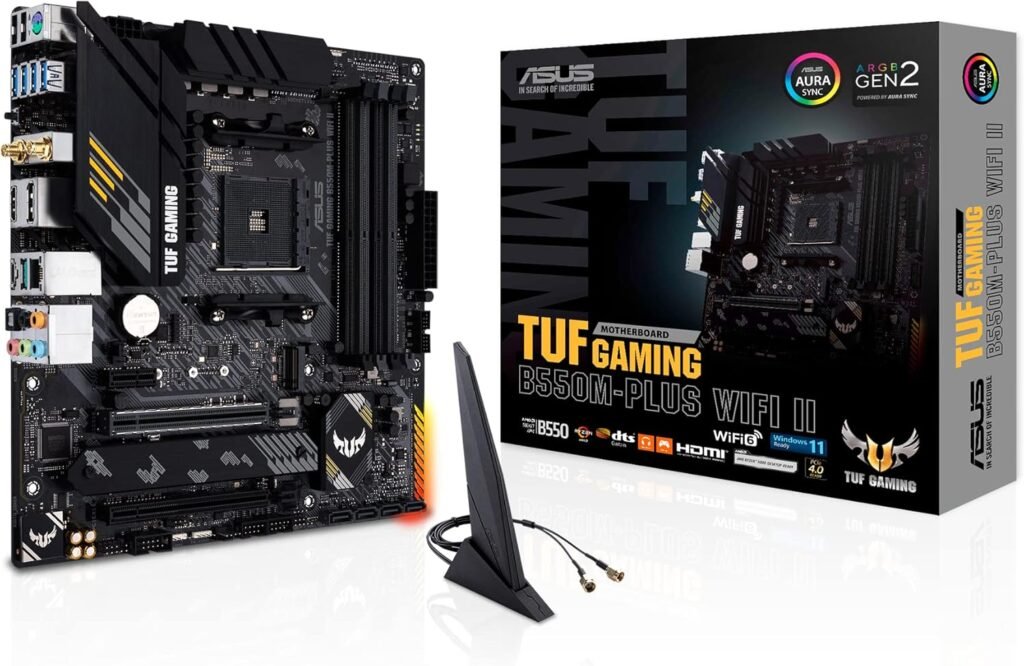
The board still leans into the TUF philosophy: military-grade components, reinforced slots, oversized VRM heatsinks, and a rugged, understated design. Add in PCIe 4.0 support, dual M.2 slots, and a surprisingly robust VRM capable of handling chips like the Ryzen 5 5600X, Ryzen 7 5800X, and even the 5900X with the right airflow—and you get a motherboard that punches far above its price range.
If you’re building a compact gaming PC, reviving an older AM4 system, or want stable, affordable performance without compromising on connectivity, the B550M-PLUS WiFi II continues to be a standout in 2026.
ASUS TUF Gaming B550M-PLUS WiFi II Review
-
Strong and stable VRM design suitable for mid-range and even some high-end Ryzen CPUs
-
Built-in Wi-Fi 6 and 2.5Gb Ethernet for modern connectivity
-
PCIe 4.0 x16 slot for current-gen GPUs
-
Dual M.2 slots, including one PCIe 4.0 NVMe slot
-
Military-grade TUF components and reinforced PCIe slot for durability
-
Excellent performance-to-price ratio in 2026
-
No front USB-C header, limiting modern case connectivity
-
Micro-ATX layout can feel tight when fully populated
-
AM4 platform is aging, with no PCIe 5.0 upgrade path
| Category | Specification |
|---|---|
| CPU Support | AMD Socket AM4 — Ryzen 5000 Series / 5000 G-Series / 4000 G-Series / 3000 Series Desktop Processors. |
| Chipset | AMD B550 |
| Form Factor | Micro-ATX (24.4 cm × 24.4 cm) |
| Memory | 4 × DIMM slots, up to 128 GB DDR4, supported overclocking up to DDR4-4866(OC) |
| Expansion Slots | 1 × PCIe 4.0 x16 slot (for supported CPUs) + additional slots (PCIe 3.0) |
| Storage | 2 × M.2 slots (M.2_1 supports PCIe 4.0 x4 & SATA, M.2_2 supports PCIe 3.0 x4 & SATA) + 4 × SATA 6 Gb/s ports with RAID 0/1/10 support |
| Networking | Integrated Wi-Fi 6 (2×2) + Bluetooth v5.2; 1 × Realtek 2.5 Gb Ethernet port with TUF LANGuard |
| Rear I/O USB Ports | 2 × USB 3.2 Gen2 (1 × Type-A + 1 × Type-C) + 4 × USB 3.2 Gen1 + 2 × USB 2.0 |
| Video Outputs | 1 × HDMI (4K@60Hz) + 1 × DisplayPort (DP 1.2) — for CPUs with integrated graphics |
| Audio | Realtek 7.1-channel HD Audio codec; supports up to 24-bit/192 kHz; includes optical S/PDIF out, audio shielding, premium capacitors |
| Power Design / VRM | 8+2 DrMOS power stages, ProCool connector, 2-oz copper PCB layers, TUF military-grade chokes & capacitors |
| Cooling/Heatsinks | Large VRM heatsink, M.2 heatsink, hybrid fan headers, Fan Xpert 2+ software control |
| RGB & Customization | Aura Sync RGB headers (2 × standard + 1 × Addressable Gen2) |
| Special Features | BIOS FlashBack™, SafeSlot reinforcement, Over-voltage & ESD protection, TUF Protection suite |
| OS Support | Windows 10 (64-bit) & Windows 11 ready (Asus) |
Key Features Overview Of ASUS TUF B550M-PLUS WiFi II
The ASUS TUF Gaming B550M-PLUS WiFi II brings a well-rounded feature set that makes it one of the most practical and reliable Micro-ATX AM4 options in 2026. Even with the platform aging, ASUS delivers a board packed with modern connectivity, strong thermals, and impressive durability for budget and mid-range gaming rigs. This level of balanced performance and value is exactly why the ASUS TUF Gaming B550M-PLUS WiFi II review continues to rank it among the best Micro-ATX B550 motherboards in 2026.
Connectivity & Ports
Despite its compact size, the board offers plenty of high-speed connectivity for peripherals and storage. You get USB 3.2 Gen2 ports at the rear—including Type-C—along with multiple USB 3.2 Gen1 and USB 2.0 ports for accessories, coolers, and external devices. There’s also HDMI and DisplayPort support for Ryzen APUs, making it a flexible choice for small-form-factor builds.
Networking
The WiFi II revision upgrades the board with Wi-Fi 6 (802.11ax) for faster and more stable wireless performance. Paired with Bluetooth 5.2 and a 2.5Gb Ethernet port, the board ensures strong, modern networking whether you’re gaming, streaming, or transferring large files across a local network.
PCIe & Expansion
At the center is a full-speed PCIe 4.0 x16 slot, enabling current-generation GPUs to perform without bottlenecks. Reinforced with ASUS SafeSlot protection, it adds durability for heavier graphics cards. Two additional PCIe slots (PCIe 3.0 x1) allow room for capture cards, sound cards, or expansion adapters.
Storage Options
The dual-M.2 layout includes one PCIe 4.0 x4 slot for fast NVMe SSDs, offering full Gen4 speeds when paired with a Ryzen 3000/5000 chip. A second PCIe 3.0 M.2 slot and four SATA ports support multi-drive setups. M.2 heatsinks help keep high-speed storage cool under sustained workloads.
VRM & Power Delivery
ASUS equips the board with an 8+2 DrMOS VRM, oversized heatsinks, and military-grade TUF components. This setup ensures stable power for CPUs like the Ryzen 7 5800X or 5700X and can even handle a 5900X in well-ventilated cases. The VRM performance is a standout strength compared to other Micro-ATX boards in its price bracket.
Cooling & Fan Control
Cooling is robust thanks to multiple hybrid fan headers, PWM/DC support, and ASUS’s Fan Xpert 2+ software for fine-tuned thermal control. The large VRM heatsinks, chipset cooling, and M.2 thermal pads make the board ideal for compact builds where airflow may be limited.
RGB & Customization
While it keeps things minimal, the board supports Aura Sync with both standard RGB and Addressable Gen2 headers. This allows lighting integration with compatible cases, coolers, and strips—even if the board itself has a more subtle look.
Performance & Gaming Results
The TUF Gaming B550M-PLUS WiFi II performs impressively well for a Micro-ATX B550 board, particularly when paired with mainstream Ryzen processors like the Ryzen 5 5600X, Ryzen 7 5700X, or Ryzen 7 5800X. In gaming workloads, frame rates remain stable and consistent thanks to the reliable VRM and strong memory compatibility. With a capable GPU, 1080p and 1440p gaming performance shows no signs of bottlenecking, and thermal behavior stays controlled, even under long sessions of esports or AAA gameplay.
Productivity workloads also benefit from the board’s optimized memory timings and stable power delivery. In benchmarks like Cinebench, Blender, and real-world content creation tests, the motherboard maintains performance parity with more expensive ATX B550 models. The VRMs keep temperatures in check, avoiding throttling during sustained CPU loads. Storage speeds on PCIe 4.0 NVMe drives are excellent, with consistent sequential read/write numbers. Overall, the performance profile is exactly what you’d expect from a well-engineered B550 board—stable, efficient, and fully capable of supporting mid-range and even some high-end AM4 chips.
BIOS & Software
ASUS continues to deliver one of the most polished BIOS experiences on the AM4 platform. The UEFI BIOS on the TUF Gaming B550M-PLUS WiFi II is clean, responsive, and organized into simple tabs that make navigation easy for beginners and experienced users alike. Overclocking settings are straightforward, with clear voltage controls, memory tuning options, and predictable fan curve adjustments. The board also benefits from ASUS’s consistent BIOS updates, which improve stability, memory compatibility, and CPU performance even years into AM4’s lifecycle.
On the software side, ASUS includes Armoury Crate, which centralizes driver updates, lighting control, and system monitoring. While some users may prefer to minimize software tools, Armoury Crate does a good job of providing quick access to Aura Sync lighting, device management, and fan tuning features. Additionally, Fan Xpert 2+ gives fine-grained thermal control inside Windows, making it easy to optimize cooling profiles for gaming or silent operation.
Comparison Section
The ASUS TUF Gaming B550M-PLUS WiFi II sits in a competitive segment, and several similarly priced Micro-ATX B550 boards offer stiff competition. The closest rival is the MSI B550M Mortar WiFi, which slightly edges out the ASUS board in VRM thermals but lacks some of the durability features and the rugged build quality of the TUF design. MSI’s BIOS is also excellent, though users seeking a more robust physical layout may prefer ASUS’s reinforced PCIe slot and larger heatsinks.
Comparison Table
| Feature | ASUS TUF B550M-PLUS WiFi II | MSI B550M Mortar WiFi | Gigabyte B550M Aorus Pro-P | ASUS Prime B550M-A WiFi II |
|---|---|---|---|---|
| VRM Quality | 8+2 DrMOS (Strong) | 8+2 Duet Rail (Excellent) | 10+2 (Good) | 8+2 (Basic) |
| VRM Thermals | Very Good | Excellent | Good | Average |
| Wi-Fi | Wi-Fi 6 (802.11ax) | Wi-Fi 6 | None | Wi-Fi 6 |
| Ethernet | 2.5Gb LAN | 2.5Gb LAN | 1Gb LAN | 1Gb LAN |
| PCIe GPU Slot | PCIe 4.0 x16 SafeSlot (Reinforced) | PCIe 4.0 x16 | PCIe 4.0 x16 | PCIe 4.0 x16 |
| M.2 Slots | 2 (PCIe 4.0 + 3.0) | 2 (PCIe 4.0 + 3.0) | 2 (PCIe 4.0 + 3.0) | 2 (PCIe 4.0 + 3.0) |
| Rear USB Ports | Good | Good | Good | Good |
| Front USB-C Header | ❌ None | ✔️ Yes | ❌ None | ✔️ Yes |
| Audio Codec | Realtek 7.1 HD | Realtek ALC1200 | Realtek ALC1200 | Realtek ALC887 |
| Build Quality | Military-Grade Components | Excellent, Premium | Good | Basic |
| Ideal For | Gaming, durability, balanced builds | Thermals, high-end Ryzen | Budget-mid builds | Basic users |
| Overall Value | High | High | Medium | Medium |
Against the Gigabyte B550M Aorus Pro-P, ASUS maintains stronger VRM cooling and better Wi-Fi capabilities, especially with its Wi-Fi 6 implementation. Gigabyte counters with more USB connectivity on some revisions, but overall stability and memory compatibility tend to be more consistent on the ASUS side. Compared to the ASUS Prime B550M-A WiFi II, the TUF model clearly wins with better power delivery, sturdier components, and a stronger overall feature set, making it the superior choice for gaming-focused builds.
Where It Falls Short
- The aging AM4 platform means no PCIe 5.0 support, which limits future upgrades beyond 2026.
- It lacks a front-panel USB-C header, making connectivity with modern cases/gear slightly less convenient.
- Being a Micro-ATX board, the layout is a bit tight when you fill slots and cables—case airflow and cable management become more important.
Final Verdict: Should You Buy the ASUS TUF Gaming B550M-PLUS WiFi II?
As highlighted throughout this ASUS TUF Gaming B550M-PLUS WiFi II review, if you’re building a compact gaming PC or upgrading an older AM4 rig, the ASUS TUF Gaming B550M-PLUS WiFi II hits the sweet spot of performance, connectivity, and durability in 2026. Its robust VRM design, PCIe 4.0 support, dual M.2 slots, Wi-Fi 6, and 2.5Gb LAN make it one of the best-value Micro-ATX B550 motherboards still worth buying. Yes, it’s not cutting-edge in terms of futureproofing, but for mainstream gaming and productivity, it delivers stable, reliable performance with very few compromises.
If you buy it, pair it with a strong airflow case and a mid- to high-end Ryzen 5000-series CPU, and you’ll have a system that performs well today and still offers reasonable upgrade headroom.